Schengen Visa from India
A Schengen visa is a single short-stay (Category C) visa that lets a traveller from India visit all 29 Schengen countries on one application. You may stay up to 90 days within any 180-day period. Indian passport holders must hold this visa; ETIAS does not apply to them.
Reviewed against official sources on 22 July 2026
What is a Schengen visa, and which 29 countries does it cover?
A Schengen visa is a single short-stay (Category C) visa that covers the whole Schengen Area, all 29 member countries, with no internal border checks between them. You make one application, receive one visa, and travel freely across the region within your permitted days and number of entries. The visa is for tourism, family visits and short business trips; it does not grant the right to work.
The 29 member countries are:



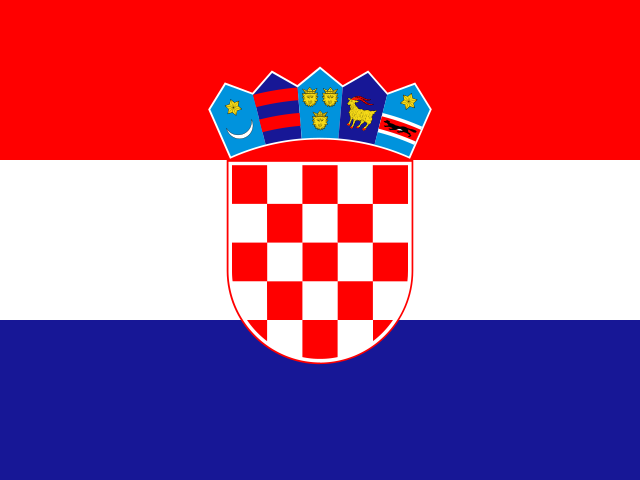
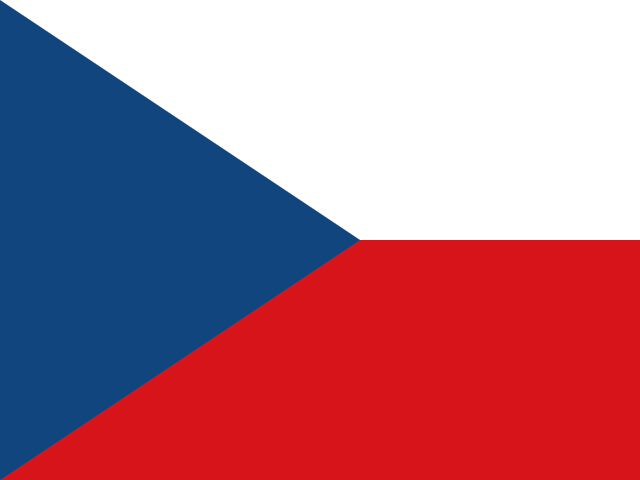
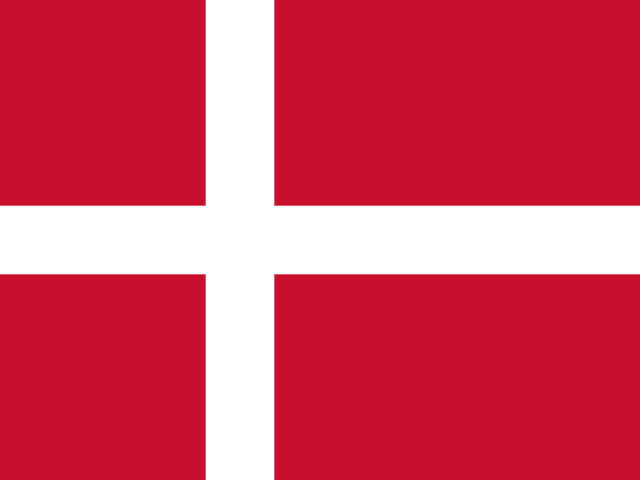







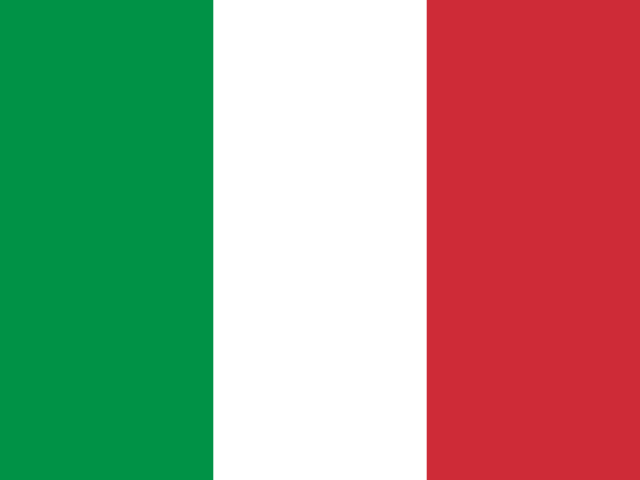




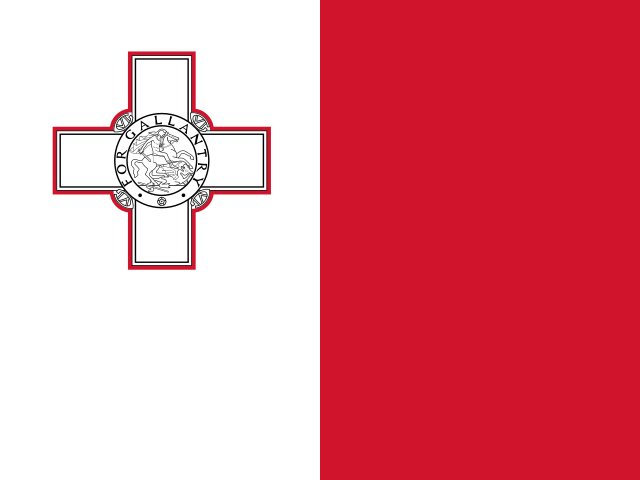





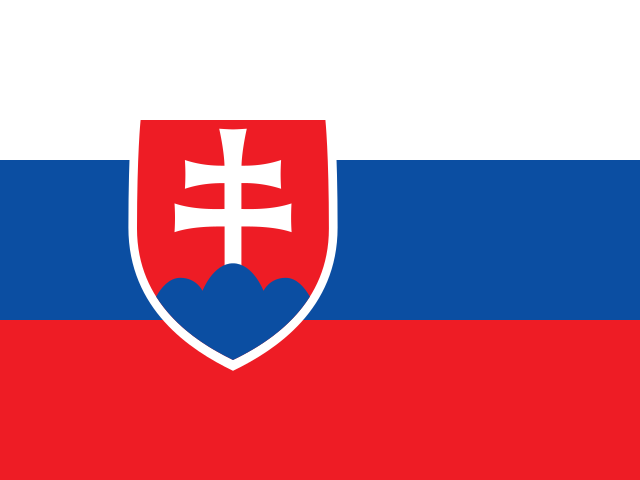




Croatia joined in 2023, and Bulgaria and Romania became full members on 1 January 2025. A point worth noting: Ireland is a European Union member but is outside the Schengen Area and issues its own national visa, so a Schengen visa does not cover Ireland. You will find Ireland grouped with our English-speaking destinations instead.
Which Schengen country should you apply through?
Apply to the consulate of your main destination, the country where you will spend the most days. If your stays are of equal length across two or more countries, apply to the country whose external border you will cross first. A specific purpose, such as a conference, an event or medical treatment, can make that country your main destination regardless of how many nights you spend there.
A short worked example makes this clear: if you plan five nights in France and two nights in Italy, France is your main destination, so you apply through the French consulate. Applying through the wrong country is one of the most common, and most avoidable, reasons an otherwise strong application is refused.
One honest word on the popular question of the "easiest" Schengen country to apply through: approval depends on the strength of your application and your genuine ties to India, not on choosing a supposedly softer consulate. Applying somewhere other than your main destination simply to improve your odds conflicts with the main-destination rule and can count as misrepresentation. A well-prepared file matters far more than the flag on the sticker.
How long can you stay: the 90/180 rule
A short-stay Schengen visa allows a maximum of 90 days of stay within any rolling 180-day period. This 90-day allowance is cumulative across all 29 Schengen countries combined, and it does not reset when you cross an internal border or when you leave and re-enter the area. On any given day, you count backwards 180 days and add up the days you have already spent in Schengen; the total may not exceed 90.
It is important to separate two ideas that applicants often confuse. Visa validity, the dates printed on your visa and the number of entries allowed, controls when and how often you may enter. The 90/180 rule controls how long you may actually stay. A multi-year, multiple-entry visa does not mean unlimited time in Europe; it still caps each period of stay at 90 days in any 180.
Which documents do you need for a Schengen visa from India?
A Schengen application from India rests on a stable core document set, listed below so you can check it at a glance. Employment letters, business proof and evidence of family or property in India strengthen the picture of your ties and your intention to return.
- Passport issued within the last 10 years, valid for at least 3 months beyond your intended departure from Schengen, with at least 2 blank pages
- Completed and signed Schengen application form
- Two recent biometric photographs, 35×45 mm, on a white background, under 6 months old
- Travel medical insurance with minimum cover of €30,000, valid across the entire Schengen Area for the full trip
- Confirmed return flight reservation and a day-by-day itinerary
- Proof of accommodation for the whole stay
- Proof of sufficient funds, usually personal bank statements for the last six months, together with income-tax returns (ITR)
- A cover letter explaining the purpose and plan of your trip
Biometrics, meaning fingerprints for applicants aged 12 and over plus a facial photograph, are captured in person at a VFS Global or BLS International application centre in India. These centres collect your documents and biometrics and forward the file to the consulate; the consulate alone decides the application. If you gave fingerprints within the previous 59 months, they can usually be reused.
How much does a Schengen visa cost, and how long does it take from India?
The consular visa fee is set by the EU and is indicative and subject to change, so confirm the current amount before you apply. A separate VFS or BLS service charge applies, capped by EU rules at 50% of the visa fee, and travel medical insurance is extra.
| Item | Indicative amount | Notes |
|---|---|---|
| Consular visa fee (adult) | about €90 | Set by the EU, subject to change |
| Consular visa fee (child 6–12) | about €45 | Children under 6 are free |
| VFS / BLS service charge | up to ~50% of the visa fee | Capped by EU rules |
| Travel medical insurance | min €30,000 cover | Mandatory, valid Schengen-wide |
| Standard consular processing | about 15 calendar days | Extendable up to 45 |
| Typical end-to-end (from India) | about 4–8 weeks | Longer in the May–August peak |
Appointment slots at application centres in cities such as Delhi and Mumbai can fill within minutes during the summer peak, when demand for France, Italy, Germany, Spain and others is highest. You can apply up to six months before travel, and applying early is the single most practical way to protect your plans. To be clear, we monitor slot availability and prepare you to move quickly, but no one can offer a priority or guaranteed appointment; slots are released on the official portals.
All figures are indicative, set by the EU or the application centre, and subject to change. Verify the current amount on the official portal before applying. Last reviewed: 22 July 2026.
2026 updates: EES and ETIAS for Indian travellers
Indian passport holders must hold a full Schengen short-stay visa to travel; they are not covered by ETIAS. ETIAS is a travel authorisation for visa-exempt nationalities only, and India is not on that list, so ETIAS does not replace the visa for Indians. ETIAS is scheduled to begin in late 2026, and even once it launches, Indian travellers will still need the Schengen visa.
Separately, the EES, the Entry/Exit System, has been fully operational across the Schengen Area since 10 April 2026. It digitally records the entries, exits and biometrics of non-EU travellers in place of passport stamps. Many pages still conflate ETIAS with the visa; getting these two facts right matters for planning your travel.
Longer-validity (cascade) visas for frequent Indian travellers
Frequent travellers from India may be eligible for a longer-validity Schengen visa under the EU cascade rules for Indian nationals, adopted on 18 April 2024. Applicants who have obtained and lawfully used two Schengen visas within the previous three years may be granted a two-year multiple-entry visa, potentially followed by a five-year multiple-entry visa if the passport has enough remaining validity.
This is a genuine improvement for regular visitors, but it is not automatic. Issuance remains at the consulate's discretion and depends on your travel history and profile, so we frame it honestly as "may be eligible", never as a guarantee.
Why Schengen applications from India are refused, and how we prepare your file
The most common reasons Indian applications are refused are insufficient or unstable finances, incomplete or inconsistent documents, insurance below the €30,000 minimum, an unclear travel purpose or weak itinerary, weak ties to India, and applying too close to the travel date. Most of these are matters of preparation rather than eligibility.
This is where a carefully assembled file earns its place. We review your documents for exactly these gaps, tailor the funds and ties evidence to your situation, whether you are salaried, self-employed, a business owner, a student, retired or travelling on an invitation, and make sure your cover letter and itinerary tell one consistent story of a genuine short visit. We cannot change the outcome, which rests with the consulate, but we can make sure your application is as clear and complete as it can be.
How The Parashars supports your Schengen application
The Parashars is a Delhi-based visa consultancy that has prepared more than 10,000 visa applications since 2017, and we regularly take on complex and previously-refused cases. Every client works with a dedicated case manager who reviews the file end to end, prepares the documentation and readies you for any questions.
Most Schengen refusals I see aren't weak travellers — they're strong cases let down by an inconsistent file. My job is to make the paperwork tell one clear, honest story.
Maya, Lead Consultant
We want to be plain about what our service is and is not. Our fee covers advisory and document-preparation work only: document checks, cover-letter and itinerary preparation and interview readiness where relevant. The visa decision rests solely with the embassy or consulate, and appointments are booked only on the official VFS Global, BLS International or consulate portals. We hold no special access, priority slots, partnership or affiliation with any visa centre, embassy or government.
Schengen visa from India — your questions, answered
Does one Schengen visa let me visit all the countries?
Yes. A single Schengen short-stay visa covers all 29 member countries with no internal border checks between them. You make one application, receive one visa, and can move freely across the whole Schengen Area within your permitted number of days and entries.
Which country should I apply to if I'm visiting several?
Apply to the consulate of your main destination, the country where you will spend the most days. If your stays are equal, apply to the country you will enter first. A specific purpose, such as a conference or treatment, can make that country your main destination instead.
How long can I stay in the Schengen Area?
A short-stay visa allows a maximum of 90 days within any rolling 180-day period, counted cumulatively across all Schengen countries. Leaving and re-entering does not reset the count. A multi-year visa controls when and how often you enter, not how long each stay may be.
How much does a Schengen visa cost from India?
The consular fee is roughly €90 for adults and €45 for children aged 6 to 12, with under-6s free. A VFS or BLS service charge and mandatory travel medical insurance are extra. These figures are indicative and set by the EU, so confirm the current amount before applying.
Do Indians need ETIAS to travel to Europe?
No. ETIAS is only for visa-exempt nationalities, and India is not on that list, so Indian passport holders must still apply for a full Schengen short-stay visa. Separately, the EES entry-exit system, live since 10 April 2026, digitally records your entries and exits in place of passport stamps.
Which Schengen country is easiest to get a visa from India?
Approval depends far more on the strength of your documents and your ties to India than on the country you choose. The rule is to apply to your main destination, and the decision always rests with the embassy. A well-prepared file matters more than picking a supposedly easier consulate.
Planning a trip to the Schengen Area?
Talk to a case manager — a frank assessment of your Schengen application and a clear next step, usually within 30 minutes in working hours.